

Diaphragm wall – geotechnics, foundations
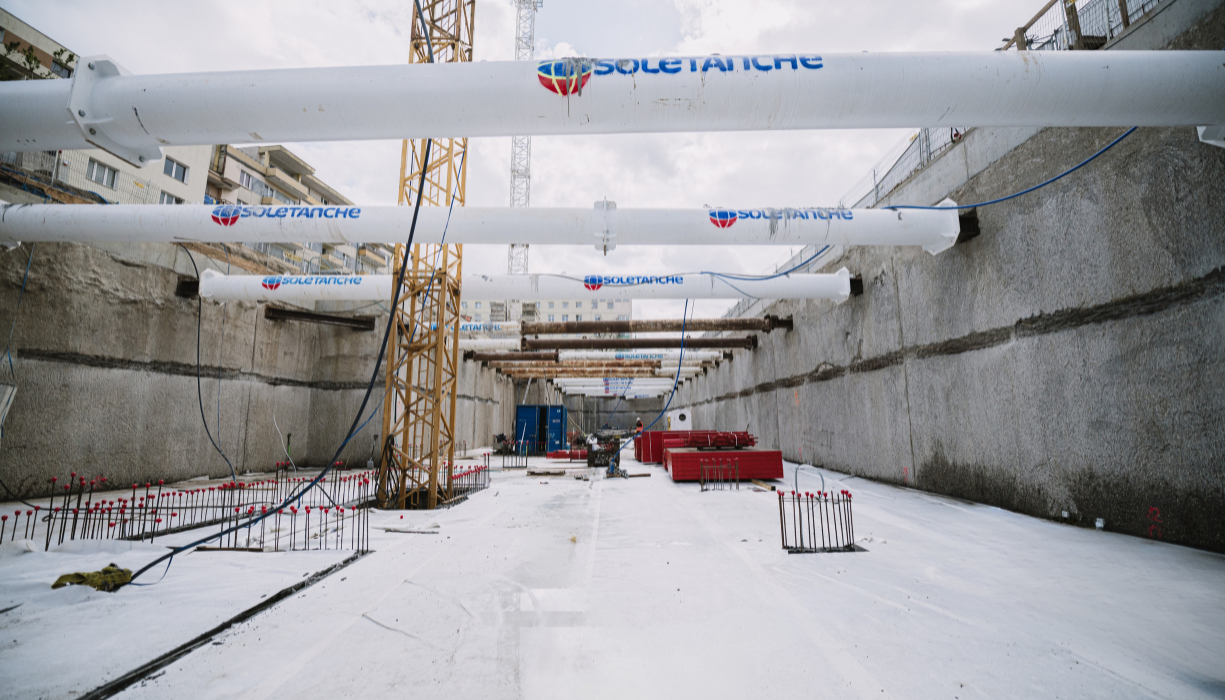
Diaphragm walls are reinforced concrete structures constructed in the ground, used as vertical retaining systems for deep excavations.
They play a key role in transferring horizontal forces resulting from earth pressure, ensuring excavation stability. Thanks to their structural performance and the application of CWS (Continuous Water Stop) / Stopsol® technology, they also provide an effective barrier limiting groundwater seepage, enabling efficient dewatering of the excavation. Diaphragm walls executed by Soletanche Poland combine the function of excavation support with that of a foundation element, transferring structural loads to deeper bearing soil layers. At the same time, they serve as the external walls of the underground storeys of the structure.
Diaphragm walls executed by Soletanche Poland combine the function of excavation support with that of a foundation element, transferring structural loads to deeper bearing soil layers. At the same time, they serve as the external walls of the underground storeys of the structure
Advantages of diaphragm walls
- They limit groundwater seepage and enable effective excavation dewatering.
- Due to their high stiffness, they provide deformation control and ensure structural stability.
- They can serve as permanent or temporary structures.
- They perform particularly well in urban environments – they can be installed in close proximity to existing buildings, under restricted headroom conditions, or on small plots.
Low-carbon concrete
At Soletanche Poland, the use of concrete mixes with reduced CO₂ emissions is standard practice.
Concrete and steel may account for 50–60% of the CO₂ emissions associated with building construction, with concrete alone representing up to 20–30% of these emissions. Implementing innovative solutions such as low-carbon concrete certified under the Soletanche EXEGY label can reduce CO₂ emissions by up to 40% compared to conventional concrete.